Friday, August 31, 2007

From Here to Paternity


Speaking of performers who had accomplished a lot at a very young age, Denver Broncos running back Travis Henry has fathered nine children by nine different women, and he's only 28. You'd think just by accident he'd have knocked up one of them twice by now.

Wednesday, August 29, 2007

The Best Album Titles of All Time


These aren't in any particular order; this will engender enough controversy among the notoriously argumentative OPC readership without adding rankings on top of it. They're also presented irrespective of the quality of the record itself, although it seems that an act with the wherewithal to come up with a great title is also generally capable of making a pretty good record. Please add your favorites in comments.

The Quality of Mercy Is Not Strnen by the Mekons: Funniest title and cover photo ever.
Nevermind by Nirvana: It's great when a band can encapsulate its ethos with a single word, even if that word is made up.
Blood on the Tracks by Bob Dylan: This is the only great Dylan album with a great title; most of his great albums have so-so titles, like Blonde on Blonde or Time Out of Mind, while his great titles are largely wasted on things like Slow Train Coming or Empire Burlesque or...
Street Legal by Bob Dylan
Bee Thousand by Guided by Voices
Butt Rockin' by the Fabulous Thunderbirds
Let It Bleed by the Rolling Stones
Let It Be by the Replacements: A much better title, oddly enough, than Let It Be by the Beatles.
Here Come the Warm Jets by Brian Eno
Hot Fuss by the Killers
Goodbye Yellow Brick Road by Elton John: It's overfamiliar now, but just imagine you're coming to it fresh, and appreciate how it looks and sounds. It's pretty great.
Pacific Trim (EP) by Pavement: This just cracks me up.
Vampire Can Mating Oven (EP) by Camper van Beethoven: Is there a word for something that's like an anagram except it scrambles syllables rather than letters?

Tuesday, August 28, 2007

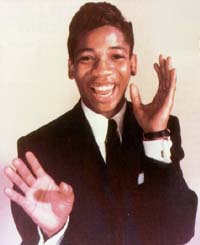
The Short Life of Little Willie John


One of the primary themes that has emerged here on "One Poor Correspondent" is how young so many of the rock & roll stars we respect and admire were during the vital points of their careers. Such is the case with the R&B singer Little Willie John.

Little Willie John really was little -- five foot four -- and unlike Elton John or Robert "Sad Eyes" John -- John was his real last name. He is probably best known for making the original "Fever," which was covered note-for-note to great effect by Miss Peggy Lee. (Miss Peggy Lee's other signature song, "Is That All There Is," was written by the famed rock & roll pioneers Leiber and Stoller, and arranged and conducted by none other than Randy Newman.) But Little Willie did it first himself, in the summer of 1956, when he took it to Number One on the R&B charts, and Number 24 on the pop charts. Despite the fact that "Fever" seems the height of sophistication in the hands of Miss Peggy Lee, Little Willie was all of 18 when he made a hit out of it.

Little Willie's last hit came in 1960, with "Sleep": he turned 23 around the time it was sneaking into the Top 20. His music career scuffling, Little Willie decided to go in a new direction in 1966 and knifed a guy after a show in Seattle -- Willie was known to have a few drinks. Convicted of manslaughter, he went to prison in Walla Walla, Washington, where he died of a heart attack in Washington State Prison in 1968. Little Willie John was 30.

My Second Post Gleaned From a Close Reading of the Liner Notes for "Sticky Fingers"

The liner notes on many albums go to great lengths to tell you who played what instrument on which song. The notes to the Rolling Stones' Sticky Fingers would seem to be one of these; they make clear, for example, that Ry Cooder played guitar on "Sister Morphine" and Nicky Hopkins played piano on "Sway" and Bill Wyman played electric piano on "You Gotta Move" (which has no bass part).

But in the cases of "Sway" and "Moonlight Mile," you don't get to find out everyone who played on those tracks. Both of those credits read "Paul Buckmaster: Strings," and while I suppose it's possible that Buckmaster played every string part on those songs, that wouldn't be a very efficient use of studio time, would it? No, I think anonymous violinists played the strings on those songs, and Buckmaster arranged the charts for them.

The only times you see a string player credited on a rock & roll record is when they're playing solo, like Scarlet Rivera or the ubiquitous cellist Jane Scarpantoni. If they're playing as part of a team, they're out of luck.

Monday, August 27, 2007

Quote of the Day

"Alberto Gonzales is the first Attorney General who thought the truth, the whole truth and nothing but the truth were three different things." -- Rep. Rahm Emanuel, D-Illinois

Sunday, August 26, 2007

Kid, Gracious Kid

As I'm sure you know, back in the 1980s Chrissie Hynde of the Pretenders had a baby with Ray Davies of the Kinks. This was shortly after the Pretenders had covered the Kinks' "Stop Your Sobbing"; I think there was a deal in place whereby if the band covered one of your songs, you then got to impregnate Chrissie.

That little girl, Natalie Rae Hynde, is now 24, and I have seen Internet reports of her studying English literature in London (which sounds plausible) and working as a model (which doesn't). I have not heard, though, about her making any music, which seems a little odd since both her parents are Rock & Roll Hall of Famers, and real ones, not like Lloyd Price or the drummer for the Rascals or anything. The bloodlines don't get much better than that.

How many other kids can say they are the child of two members of the Rock & Roll Hall of Fame? I found four others:

Ronnie Turner
(son of Ike and Tina)
China Kantner (daughter of Paul Kantner and Grace Slick)
Chynna Phillips (daughter of Michelle and John Phillips)
Rhonda Ross Kendrick (daughter of Diana Ross and Berry Gordy, who is inducted as a nonperformer)

So if you want to get yourself into the Rock & Roll Hall of Fame, you might want to name that kid China, or some variation thereof. It's interesting to note that Chynna Phillips, who sang the soporific, ironically titled "Reckless" with Wilson Phillips, is the only one who's made music her career.

But really, I thought there would have been more. Some possible future additions to the list:

Chastity Bono (if Sonny and Cher get inducted)
Elijah Blue Allman (if Cher gets inducted)
Sally and Ben Taylor (if Carly Simon gets inducted, which she would be if I had anything to say about it, and, you know, I really ought to)
Jackson Smith (and at least one other whose name I couldn't find, but they'll count if the MC5 get inducted)

The Costanza Stratagem

The other day when I was getting a haircut, I saw a man out at the barbershop wearing a dark green L.L. Bean sweat suit, with a matching sweatshirt and sweat pants. Now, I'm the last person who should be criticizing other people's fashion choices, but this is a strategy I just can't fathom: "I'm willing to make an effort and spend some money to dress nice when I go out, but not at the cost of sacrificing my sweat pants."

Friday, August 24, 2007

When We Was Fab


A commenter on my Archies item drew an implicit comparison between that group and Milli Vanilli, the German studio group of the late 1980s that hired two dreadlocked pretty boys to be its stand-in. The whole Milli Vanilli phenomenon is fascinating to me, not least of which is that people forget just how popular that group was. They had three Number One singles and two other Top Five hits, in addition to their much-ballyhooed Grammy win as Best New Artist in 1990.

But as soon as Rob and Fab were revealed as put-on artists, the public turned on them as if they had signed with the Yankees. Part of this was their incredible obnoxiousness: Before their unmasking, one of those dudes told Time magazine "We make better music than Paul McCartney. We make better music than Bob Dylan." And I don't think the producer ever came out and sheepishly admitted, "Yeah, we shouldn't have lied, but we had found these great grooves and figured they wouldn't get a hearing if people thought they had come form a bunch of old guys in Germany." That would have gone a long way toward rehabilitating the whole project, but for better or worse, Rob and Fab remained the faces of Milli Vanilli.

And then there was their Achilles' heel: Their music was terrible. Just unconscionably bad, three Number One hits or no three Number One hits. Weak rhythms, almost no melody, English-as-a-second-language lyrics. Because of that, no one ever stepped forward and said, "They were a fraud, but I still enjoy listening to their music." As soon as people had an excuse to forget them, they did.

I can recall hearing "Girl I'm Gonna Miss You" on my car radio and leaving it on all the way through, just because I was always convinced that it couldn't possibly be as mindbendingly awful as I remembered it, but it always was:

It's a tragedy for me to see the dream is over
And I never will forget the day we met
Girl I'm gonna miss you


There's a Milli Vanilli movie in the works now. I think I speak for legions of music fans when I say: I don't care.

Thursday, August 23, 2007

Pour Some Sugar on Me

I hate to break it to you, kids, but the Archies weren't a real band. Jughead, for one, could barely play the drums at all. Their records were played and sung by outside people, most notably a singer named Ron Dante, which would later also provide the singing voices for the Chan Clan, progeny of the Amazing Chan.

I have no idea of the provenance of this clip, but apparently at some point Ron Dante stepped out from behind the animation to perform some of his Archies hits. Here he is doing "Sugar, Sugar" (which was co-written by Andy Kim of "Rock Me Gently" fame), accompanied by Ron Dante on drums, Ron Dante on guitar, and Ron Dante on tambourine. The set looks a little like it might be "The Merv Griffin Show," but I really have no idea.

Next week: The Banana Splits were just a bunch of guys in costumes.

Wednesday, August 22, 2007

My Odd Couple Mea Culpa


I have tremendous respect for Jack Klugman, but I'm afraid the man has done me and you, my readers, a disservice. I mentioned that in his memoir Klugman described how "The Odd Couple" switched from being shot on film to being shot in front of an audience on videotape during the first sesason. I just got a copy of the first season DVD of The Odd Couple" (smartly packaged with a whopping five discs in a normal-sized DVD sleeve, rather than a bulky book of them) and I can tell you: He's wrong. The entire first season was shot on film, with no studio audience. The enormous changeover in the show happened over the summer between the first and second seasons.

I apologize. I will see if Garry Marshall has any explanation for this.