It was weird watching Dan Quayle walking in as part of the line of dignitaries. I had almost forgotten that the gentleman from Indiana had once held a central role in our nation's governance.
For a second, the light playing across President Carter's face made it look as if he had grown a goatee. That would have been awesome.
Carter is in much better shape than President H.W. Bush. That's not so surprising; Bush is actually older than Carter.
Hey, Sasha and Malia, don't you have school today?
Everyone who really believes that Dick Cheney is in a wheelchair because he hurt himself moving boxes, raise your hand.
Tuesday, January 20, 2009


Sunday, January 18, 2009
The Road to Congress

"Besides being a professional comedy team, Tom and I are international communist revolutionaries, and we believe that nothing can really be changed in this country through the democratic process." - Minnesota senator-elect Al Franken, October 14th, 1978
Saturday, January 17, 2009
Nobody Knows My Name
Well, we know it's not Jane, or Stacy, or Mary Jo Lisa. I think no one seriously considered that it might be Hell, or "quiet girl," and it's clearly not "her."
So what is it? It's Katie White. Ladies and gentlemen, the Ting Tings:
So what is it? It's Katie White. Ladies and gentlemen, the Ting Tings:
Friday, January 16, 2009
Still Life
NBC's Saturday Night Live opened its fourth season, on October 7th, 1978, with something unusual: no host. When I watched this show in its first airing, it seemed to me that for some reason, the show had diddled with its format to eliminate the celebrity host; watching it now, I'm not sure what they were trying to do. In the opening montage, the Rolling Stones were named in the place where Don Pardo usually introduced the host ("starring the Rolling Stones!"), but a heretofore unnamed Mayor Ed Koch actually came out to do the monologue, doing a lame, self-congratulatory skit with John Belushi (congratulating Belushi, not Koch).
No Rolling Stones appeared until the post-monologue sketch, a Tomorrow show parody with Dan Aykroyd's Tom Snyder interviewing a raspy Mick Jagger. This was followed by Charlie Watts and Ron Wood having small parts as customers in a Greek restaurant sketch; then, at the end of the show, Mick and Woody appeared as extras in an unfunny Dave Mable's Danger Probe sketch. That was it for the putative hosts.
Except, of course, after Weekend Update, Laraine Newman came out and screamed, "Ladies and gentlemen, the Rolling Stones!" and the Stones came out and did one of the most infamous sets of their career. Legend has it that during the week, their rehearsals were so good that everyone on the floor would crowd around to hear them, and the cast members were afraid of being blown off their own show come Saturday night. That didn't happen.
The Stones were given an uninterrupted three-song set, the first since the Band's two years earlier. They opened with "Beast of Burden," but it was clearly wrong from the first; the groove was sloppy, the guitars hardly playing together, the mix so far off that an electric piano dominated the sound. Jagger's voice was hoarse and ragged, barely able to keep in tune. I can't for the life of me figure out how that happened. Here's a band that's used to being on tour for months at a time, doing two-hour sets every night, and Jagger had always been able to keep his voice in shape. Now, doing a three-song set that was their only appointment for the week, he was thoroughly shot.
Keith Richards, surprisingly enough, took a long, simple solo at the end of "Beast of Burden," and he was great, but Jagger strutted around the tiny stage dancing and posing like he was afraid someone might not be looking at him at every second. He reminded me of Madonna. Keith, looking more like Jeff Conaway than ever, was content to stay towards the back of the stage. Jagger strapped on a guitar for "Respectable," which was slightly better than "Beast": this was the song Mick where began abusing Woody, pushing him around the stage, licking his lips during his guitar solo. It continued during "Shattered" - the perfect song for SNL - when Jagger tore off his sports coat and started whipping Woody with it in the middle of the song. It was pretty funny - we've all wanted to do that to Ron Wood at some point or other, except for the lip-licking part.
But Jagger's voice wasn't getting any better, and at points he even got the lyrics mixed up. "Shattered" doesn't even have a melody, and still Mick wasn't able to sing it. The band finally locked into a groove about halfway through the song, playing the riff at seemingly twice the pace of the Some Girls version, but Jagger's vocal was distractingly bad. He tried to sing "Don't you know the prime rate's going up, up, up, up, up!" but it all came out as the same note. He ripped open his T-shirt.
Then they were done. The crowd went wild. They hadn't exactly been terrible, but they were a long way from good.
Going back to the whole hosting question, I wonder if the Stones hadn't agreed to be the musical act as long as they were the only celebrity guests on the show, then chickened out of doing some sort of monologue. They were really, really big at that point - imagine a musical legend, the greatest rock & roll band in the world, except they were still topping the charts. They were by far the biggest band that had ever appeared on the show. I imagine they got whatever they asked for.
Thursday, January 15, 2009
Turning Japanese
Frequent OPC commenter Kinky Paprika, our only regular whose parents were big fans of "They Ain't Making Jews Like Jesus Anymore" and also the only one who is heir to a Hungarian-spice fortune, has made an invaluable contribution to a long-dead thread, posting a video of Chicago singing "Question 67 and 68" in Japanese. According to the site where Kinky found this, Chicago had recut this song in Japanese in 1971 and performed it thusly on a tour of Japan in 1972. This clip, from 1995, purportedly is the only time since then that Robert Lamm and Jason Scheff - who replaced Peter Cetera on vocals and bass in 1985 - have sung it in Japanese onstage.
I should warn you: It's terrible. Scheff sings the lyrics like he's reading nonsense syllables out of a book by Dr. Seuss, and is clearly looking down at a TelePrompTer the whole time. On the brighter side, in case you couldn't figure out which song it was, he helpfully renders "Questions sixty-seven and sixty-eight" in English at the end.
Thanks, Kinky!
Wednesday, January 14, 2009
Class of '09
The newly announced inductees for the Rock & Roll Hall of Fame, as seen through the prism of the Baseball Hall of Fame:
Run-DMC: Rickey Henderson One thing Rickey knew how to do was to walk this way. The kings of rock did it first and did it best, and even if hip-hop or a .400 OBP took a little time to get accepted by the cognoscenti, there was no denying them when their time came.
Metallica: Jim Rice The accepted meme around Rice is that he was the most feared hitter in baseball, and there was never anything scarier in rock than the glower of James Hetfield. Both gained attention early for some impressive accomplishments - rolling up over 400 total bases in a season, writing heavy-metal songs with eight different time signatures - then repeated those achievements at a lesser, unremarkable level, but long enough to get the call.
Jeff Beck: Bruce Sutter A highly developed purveyor of something with limited value, Beck was a guitar god in that British jazz-blues field. Beck never had a hit (this is a solo nomination, so his work with the already-inducted Yardbirds doesn't count), although a lot of people who are more familiar with such things than I am say he's really good. I'll take their word for it, but to me, he's basically a less-funny Nigel Tufnel.
Little Anthony and the Imperials: Dean Chance Little Anthony recorded one classic single, the utterly charming 1958 hit "Tears on My Pillow," and followed that up with two more worthy top ten hits, "Goin' Out of My Head" and "Hurts So Bad." Dean Chance was a great pitcher, if only for a moment, winning the Cy Young Award in 1964, when he led the AL in wins, ERA and shutouts with a staggering eleven. He won 20 games again in 1967, too, his "Goin' Out of My Head" season. "The Little River Band would have been a saner choice," a friend emailed me this afternoon. "So would Little Steven and the Disciples of Soul." To which I say: Come on. "Tears on My Pillow" is really good. But I'm not ruling out Little Eva.
Bobby Womack: Tony Perez The versatile soul man could do it all, although in a lot of cases he was relegated to sideman on greater artists' records, like Sly Stone's There's a Riot Goin' On or Janis Joplin's Pearl or Joe Morgan's Reds.
Wanda Jackson: Dizzy Dean The hellion whom no one could tame flamed out early but left a mark on everyone who heard her. She later found success as a country and gospel singer, just as Dean did behind the mike as a slinger of English. Nick Tosches said you could fry an egg on her mons venus; his opinion of Dizzy Dean's genitalia has gone unrecorded.
Still on the outside looking in War: Tim Raines Both suffer from the fact that their most visible moments - Raines as a fourth outfielder on the late-90s Yankees, War backing up self-important white bluesman Eric Burdon - didn't showcase them at their best. Latino funk, like on-base skills, still has a hard time getting respect.
Tuesday, January 13, 2009
Continental Drift
Yesterday I mentioned that the only winner of the Eurovision song contest that made an impact on the American charts was "Waterloo" by Abba, which went to Number six in the summer of '74. But there were two other Eurovision winners - both North Americans, oddly enough - who are very familiar names as well.
In 1982, Celine Dion, who is from Charlemagne, Quebec (and the youngest of fourteen children), pulled a Zola Budd and passed herself off as Swiss in order to win the 1988 Eurovision contest with a song called "Ne partez pas sans moi." It doesn't appear that it was ever released as a single here in the U.S. The next year, her manager and future husband Rene Angelil sent her to the Ecole Berlitz to learn English, and before you knew it, "My Heart Will Go On" was inescapable.
Then, in 1997, Katrina Leskanich, straight outta Topeka, Kansas, appeared with her group Katrina and the Waves as the representatives from the United Kingdom (Katrina has lived in England since 1976). They did a song called "Love Shine a Light," which won the biggest landslide in the history of Eurovision, twelve years after "Walking on Sunshine" had ruled the summer of 1985. It went to Number Three in the U.K., but failed to chart here, and Katrina and the Waves broke up shortly thereafter. Katrina went on to record a solo cover of "Hitsville U.K." for a tribute to Sandinista! I haven't heard it.
Mop Top
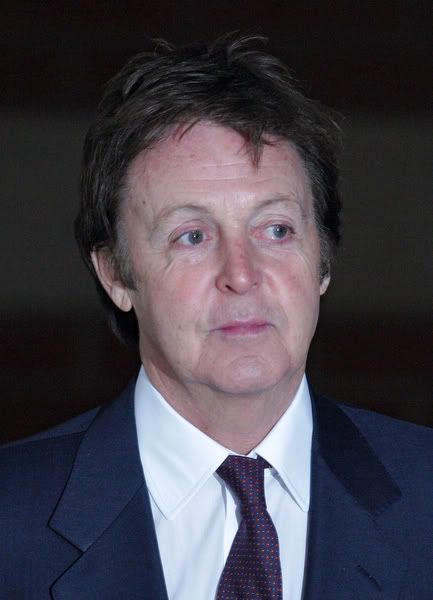
Gavin left the following comment on an old thread:
From John Colapinto's profile of McCartney in the June 4, 2007 New Yorker:
"McCartney's hair, which he admits to dyeing, still falls in bangs over his forehead...."
It's possible Colapinto is a really bad judge of hair, but it is an up-close observation that seems to go against the "Paul is bald" thesis.
Dyeing his hair doesn't preclude McCartney from having a piece as well, of course. Dick Cheney, to take one example, is both bald and gray-haired. I spent some time today looking for photographic evidence that Paul might just live and let dye, hoping to find something showing hair actually coming out of his scalp. In a way, this is unfair, since McCartney has worn his hair over his forehead since about 1962, but George and Ringo used to wear it like that as well, and each managed to pull it back in the Beatles Anthology.
The best photo I found is the one at right, which you can see larger here. It is just possible that a bit of the hair on the right side of McCartney's forehead is attached to his skin. But it also looks to me like there's an unnatural layer of hair over his real hair, further down that side of his face. You make the call.
Monday, January 12, 2009
Speaking in Tongues

One of the most leftfield AM radio hits of the 1970s - a decade with more than its share of leftfield hits - was Mocedades' "Eres Tu," which went to Number Nine in 1974. "Eres Tu" came out of the Eurovision song contest, the same competition that would later spawn Abba, in 1973. At the time, it was quite controversial, since the song's composer was accused of plagiarizing Yugoslavia's 1966 entry in that contest, "Brez besed." If you've got to steal your musical cues from Yugoslavs, you're hurting in my book.
Mocedades was actually Basque, out of Bilbao, Spain. It means "youth." I don't guess they let Basques compete separately in Eurovision, because "Eres Tu" was Spain's entry that year.
"Eres Tu" finished second at Eurovision, where it lost to Anne-Marie David's "Tu te reconnaîtras," out of Luxembourg; it was Luxembourg's second straight win at Eurovision, although neither song made a dent on the American charts. In fact, near as I can tell, the only Eurovision winner to ever make the Top Forty in the U.S. was Abba's "Waterloo." The very first Eurovision winner, back in 1956, was a song out of Switzerland by Lys Assia called "Refrain," which is about the most Euro title for a song I can think of.
"Eres Tu," though, crashed into the Top Forty in February 1974, on a label called Tara, which may well have been formed just to release that song. The single's label number was 100, and I can find no record of any other songs on Tara. The B-side was an English language version of "Eres Tu" called "Touch the Wind" - which is strange because "eres tu" actually means "you are." But everything about this record was strange.
Do you know how many foreign language songs have gone to Number One in America? It's not that many, and there's a huge trough between 1963 and 1987, which Mocedades was trying to fill. Even Falco, who seemed like an idiot, knew enough to record songs in English. Here's the foreigner five:
"Nel Blu Dipinto Di Blu (Volare)," which no one has ever called anything but "Volare," by Domenico Modugno, 1958
"Sukiyaki," by Kyu Sakamoto, 1963
"Dominique," by the Singing Nun, 1963
"La Bamba," by Los Lobos, 1987
"Macarena," by Los Del rio, 1996
Here's Mocedades' performance in the 1973 Eurovision song contest. Dig that bowtie on the second guy from the left:
Radio Days
Howard Stern and Rush Limbaugh - probably the two most talented radio performers of their generation - were both born on this day, Stern 55 years ago and Limbaugh 58 years ago.
Subscribe to:
Posts (Atom)