Out on the byways of America today I saw a license plate holder that read COURT REPORTERS ALWAYS GET THE LAST WORD.
I wonder how many of those they sold.
Tuesday, September 23, 2008


Paid tha Cost to Be tha Boss

Bruce Springsteen, erstwhile member of the Jersey Shore rock groups the Castiles, Earth, Child, Steel Mill, and Dr. Zoom and the Sonic Boom, turns 59 today. Here's a partial list of artists who have paid an early birthday tribute to Springsteen by covering one of his songs:
Solomon Burke, "Ain't Got You"
The Band, "Atlantic City"
Maria McKee, "Backstreets"
10,000 Maniacs, "Because the Night"
Roger Daltrey, "Born to Run"
Elvis Costello, "Brilliant Disguise"
Warren Zevon, "Cadillac Ranch"
Mary Chapin Carpenter, "Dancing in the Dark"
The Smithereens, "Downbound Train"
Robin Williams, "Fire"
Air Supply, "4th of July, Asbury Park (Sandy)"
Pearl Jam, "Growin' Up"
Johnny Cash, "Highway Patrolman"
Joe Cocker, "Human Touch"
Mike Love, "Hungry Heart"
Frank Black, "I'm Going Down"
Tori Amos, "I'm on Fire"
David Bowie, "It's Hard to Be a Saint in the City"
Los Lobos, "Johnny 99"
Steve Earle, "Nebraska"
Jerry Lee Lewis, "Pink Cadillac"
Aimee Mann and Michael Penn, "Reason to Believe"
Deana Carter, "State Trooper"
Elliott Murphy, "Stolen Car"
Ray Coniff, "Streets of Philadelphia"
Cowboy Junkies, "Thunder Road"
Travis Tritt, "Tougher Than the Rest"
Ani DiFranco, "Used Cars"
Plus, of course, Manfred Mann's Earth Band, the Pointers Sisters, and too many others to count.
Thanks to Matt and Lori for help in researching this post
Monday, September 22, 2008
Old Coot

Walter Brennan died exactly 24 years ago (well, 24 years ago yesterday, but you'll excuse me). Besides being the winner of three Best Supporting Actor Oscars (for Come and Get It, The Westerner, and Kentucky, none of which I've seen), Brennan is also the progenitor of the greatest spoken-word record in the rock era.
I speak of course of "Old Rivers," Brennan's tribute to his farm's hired hand and his mule, which went to Number Five in 1962. (Despite the fact that Brennan was known for his work in Westerns, he was actually from Swampscott, Massachusetts.) One of the most marvelous effects of this piece comes in the chorus, which goes:
One of these days
I'm gonna climb that mountain
Walk up there among them clouds
Where the cotton's high
And the corn's a-growin'
And there ain't no fields to plow.
Although Old Rivers is presented as the epitome of a hardworkin' man, Brennan provides a little clue as to his underlying attitudes when he reads the chorus; each time, he pauses for a little stammer on the word "fields," as if he wants to say another word that begins with F but immediately thinks the better of it.
I believe this is the same reason Roger Daltrey stutters on the line "Why don't you all f-f-f-fade away" in the Who's "My Generation." (I suspect, in fact, that the whole stuttering trope was introduced simply for that one effect.) But the Who didn't have anything on Walter Brennan.
Sunday, September 21, 2008
Under the Covers
Quick, who had a Top Forty hit covering a Who song? Nope, not Tina Turner; a studio group from Philadelphia called the Assembled Multitude went to Number Sixteen in 1970 with "Overture from Tommy (A Rock Opera)." Tom Sellers, the mastermind behind the group, was only 21 or so (his biographical data is hard to come by) at the time he was arranging instrumental versions of not just his only hit but the Beatles' "I Want You (She's So Heavy)" and "Ohio." I'm probably forgetting something, but that may be the only Who cover to reach the Top Forty. (Limp Bizkit's cover of "Behind Blue Eyes" reached Number Twenty-Four on the Billboard Top 40 Mainstream in 2004, which you can count if you want.)
Now, who had a hit with a cover of a Sly and the Family Stone song? Here's where we turn to Ike and Tina, who went to Number Thirty-Four in August 1970 with their version of "I Want to Take You Higher," credited actually to Ike & Tina Turner & the Ikettes. Sly's original was on the charts for three weeks in early spring of 1970, two months before Ike and Tina crashed the party.
There may be other Sly Stone covers in the Top Forty, but I can't think of them right now. I've been really busy lately.
Now, who had a hit with a cover of a Sly and the Family Stone song? Here's where we turn to Ike and Tina, who went to Number Thirty-Four in August 1970 with their version of "I Want to Take You Higher," credited actually to Ike & Tina Turner & the Ikettes. Sly's original was on the charts for three weeks in early spring of 1970, two months before Ike and Tina crashed the party.
There may be other Sly Stone covers in the Top Forty, but I can't think of them right now. I've been really busy lately.
Friday, September 19, 2008
Dunn on Deck
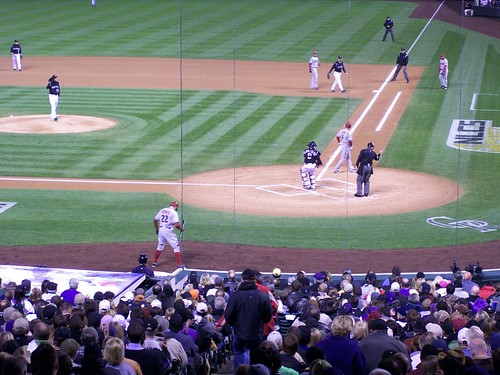
I feel like I need to record this for posterity: I was at the Rockies-Diamondbacks game tonight, and I noticed that when Arizona's galoot of a slugger, Adam Dunn, is on deck, he stands about as close to the plate as is possible without getting hit by a swinging bat. You can't see this kind of thing on TV, only at the ballpark, and I thought you would like to know.
Most players, when they're in the on-deck circle, don't stand in the actual circle but they do stay back toward the fence, or at least on the dirt warning track that encircles the field. But Dunn, who looks as if Will Ferrell is playing him in a movie, makes a point of standing on the grass cutout that encircles the infield. As you can see in the picture below, the grass is fairly narrow at Coors Field, leaving Dunn maybe a dozen feet from the hitter. If he reached out his bat, and the batter reached out his bat from the batter's box, they could touch bats, although that would look totally dorky.
In this game, Dunn was batting behind Conor Jackson, a righthanded hitter, and the Diamondbacks' dugout was on the third-base side, so Dunn was set up perfectly to stand as close as he wanted. It would break several laws of physics for Jackson to be able to foul off a ball that would have hit Dunn, but if Arizona had been on the first-base side, or if Dunn had been following a lefty, it could have been lethal.
I don't know why he does it: He doesn't seem to look at the pitcher any more intently than anyone else, so I can't understand what advantage he would gain. He's too much of a goofball to seek out little advantages like that anyway. Then again, Dunn did homer tonight, so maybe it's working for him.
Wednesday, September 17, 2008
Love Potion Nos. Nine and Ten
Up until maybe a year ago, I'd had always heard the last verse of the Clovers' 1959 hit "Love Potion Number Nine" thusly:
I didn't know if it was day or night
I started kissin' everything in sight
But when I kissed a cop down on Thirty-Fourth and Vine
He broke my little bottle of Love Potion Number Nine
But recently on the oldies station, I've been hearing a version that goes:
I didn't know if it was day or night
I started kissin' everything in sight
I had so much fun that I'm goin' back again
I wonder what happens with Love Potion Number Ten
Other than that changed verse, it sounds exactly like the other version. The song has been recorded by many groups, so I thought it was possible that the "love potion number ten" version was by someone else, but apparently it's also the Clovers. According to someone calling himself Doctor Music, Number Nine was the 45 version, and Number Ten was the LP version.
That answers one question, but it also invites many others. Why would Leiber and Stoller put different versions of a song on the LP and the 45? Was anyone really buying LPs in 1959? Apparently, the Clovers first cut the Nine version, which was released as a single. When this was a hit, they went to make an album, also called Love Potion Number Nine, but with new lyrics on the title track.
Why? I have no idea. I guess Leiber and Stoller liked the new verse better.
I didn't know if it was day or night
I started kissin' everything in sight
But when I kissed a cop down on Thirty-Fourth and Vine
He broke my little bottle of Love Potion Number Nine
But recently on the oldies station, I've been hearing a version that goes:
I didn't know if it was day or night
I started kissin' everything in sight
I had so much fun that I'm goin' back again
I wonder what happens with Love Potion Number Ten
Other than that changed verse, it sounds exactly like the other version. The song has been recorded by many groups, so I thought it was possible that the "love potion number ten" version was by someone else, but apparently it's also the Clovers. According to someone calling himself Doctor Music, Number Nine was the 45 version, and Number Ten was the LP version.
That answers one question, but it also invites many others. Why would Leiber and Stoller put different versions of a song on the LP and the 45? Was anyone really buying LPs in 1959? Apparently, the Clovers first cut the Nine version, which was released as a single. When this was a hit, they went to make an album, also called Love Potion Number Nine, but with new lyrics on the title track.
Why? I have no idea. I guess Leiber and Stoller liked the new verse better.
Tuesday, September 16, 2008
Happy Birthday, Betty

Lauren Bacall, the Scarlett Johansson of the 1940s*, turns 84 today. She's been widowed for more than 50 years now. She met Humphrey Bogart on the set of To Have and Have Not when she was only 19 (he was 44) and, at five foot eight and a quarter inches tall, just a smidge taller than Bogie. Because of that, she spends most of the movie with her head slightly dipped, looking out at him through the top of her eyes - it's a very seductive pose. Someone once said (I can't remember who, but it was probably Howard Hawks) that Bogart fell in love with Bacall's character in the movie, so she had to be that character for the rest of their married life.
I love the fact that everyone calls Bacall "Betty" (she was born Betty Joan Perske) - Johnny Carson used to call her that every time she was on his show, and Juliette Binoche called her "Betty" at the Oscars a few years ago. These aren't even her close friends, I'm guessing. It's just that everyone recognizes "Lauren Bacall" as nothing but a stage name. She also gave the Rat Pack its name (she was briefly engaged to Sinatra after Bogie's death). That's more than you can say about a lot of people.
* I promise you I thought of this comparison last week while watching To Have and Have Not, and I didn't remember until today that Rich Cohen had called Bill Murray our Humphrey Bogart.
Monday, September 15, 2008
Here in My Car
The 1971 movie Two-Lane Blacktop is James Taylor's only screen-acting performance, and it's not hard to see why: He's a poor actor. After many of his line readings, even those sitting at home watching the DVD will be tempted to call out, "Cut! Let's try that one again."
The role is well-crafted for him, though: the steely-eyed, taciturn driver of a 1955 Chevy, who only speaks if it's absolutely necessary. Mostly he just glares through the windshield, or halumphs around, stooped, lean, excessively tall, elbows slightly bent: At six-foot-three, he's built exactly like Shaggy (the detective, not the reggae singer). And when he does use it, though, that voice is something else, like burnished teak.
It doesn't really matter, because Two-Lane Blacktop is mostly about the American vistas. These low-budget movies, filming on the road, captured America better than any stdio output could. Would a set designer really notice the rack of empty glass bottles next to the Coke machine, or the cylinder of cheap sunglasses for sale in a truck stop? If you want to know what these United States looked like back in 1971, here's the movie for you.
Even in the cruddy, sensationalist trailer, you get a little sense of that:
The role is well-crafted for him, though: the steely-eyed, taciturn driver of a 1955 Chevy, who only speaks if it's absolutely necessary. Mostly he just glares through the windshield, or halumphs around, stooped, lean, excessively tall, elbows slightly bent: At six-foot-three, he's built exactly like Shaggy (the detective, not the reggae singer). And when he does use it, though, that voice is something else, like burnished teak.
It doesn't really matter, because Two-Lane Blacktop is mostly about the American vistas. These low-budget movies, filming on the road, captured America better than any stdio output could. Would a set designer really notice the rack of empty glass bottles next to the Coke machine, or the cylinder of cheap sunglasses for sale in a truck stop? If you want to know what these United States looked like back in 1971, here's the movie for you.
Even in the cruddy, sensationalist trailer, you get a little sense of that:
Saturday, September 13, 2008
David Foster Wallace, 1962-2008

David Foster Wallace has taken his own life at the age of 46. I never met or spoke with him, although he wrote for Rolling Stone while I was an editor there. His work for our 9/11 issue inspired such editorial passion that it ended up being indirectly responsible for a precisely kicked dent in a cubicle right outside my office, which is probably still there. He also write a brilliant piece from the campaign trail on John McCain early in 2000, shortly before I arrived at the magazine, which won a National Magazine Award.
His fiction was brilliant, but his reported pieces were what I really enjoyed, going to the Illinois State Fair or telling tales of being a highly ranked young tennis player. Most of all, his work vibrated with the joy of writing, which makes it all the more shocking that he would have decided he didn't want to live anymore.
Wallace grew up in central Illinois, and he never tried to pretend he hadn't. I loved that about him, too.
Plurality
I understand that British people tend to construe their plural nouns as plural, even when they sound singular, so that they would say, "The Who are embarking on another farewell tour," whereas an American speaker would more likely say, "The Who is embarking on another farewell tour."
So what are we to make of the first two lines of the chorus to Elvis Costello's "Oliver's Army"? To wit:
Oliver's army is here to stay
Oliver's army are on their way
Is there some subtle distinction between the two subjects that I am not grasping? Or is ol' Declan just having a bit of a larf on us?
So what are we to make of the first two lines of the chorus to Elvis Costello's "Oliver's Army"? To wit:
Oliver's army is here to stay
Oliver's army are on their way
Is there some subtle distinction between the two subjects that I am not grasping? Or is ol' Declan just having a bit of a larf on us?
Subscribe to:
Posts (Atom)